Traumatic experiences can change a person’s mental image of the world, their ability to understand and express feelings, and their social behavior on a very basic level. Most mental healthcare systems primarily identify a disease mentally by making a list of clinical symptoms to diagnose. However, profound psychological recovery needs a totally different way of thinking, one that goes beyond the patient’s current symptoms and tries to explore their entire life story.
We at Open Minds Psychiatry use a healthcare model that poses an altogether different leading question. Rather than asking, “What is wrong with you?” our first move is to get to the bottom of the question, “What happened to you?” This is what trauma-informed psychiatry is all about, an empathetic, science-backed mental health treatment method that acknowledges the significant and far-reaching effects of traumatic stress on the human brain, body, and nervous system.
What is Trauma-Informed Psychiatry?
Trauma-informed psychiatry tries to change the way care is delivered by assuming the person has trauma in his/her life. Administrators and clinicians can work together on how to implement such a system and a treatment plan for the patient. To be traumatized does not only mean having been in one episode of an extreme event (getting hit in an accident or death of a loved one). It also means experiencing complex and chronic stressors like the ones in childhood or systemic oppression or relational abuse as these can be very traumatizing situations. So the trauma informed psychiatry looks at the whole person and the history in order to give proper care.
It often has been pointed out that working in the psychiatric hospital setting doctors can make their patients feel that they have no choice, that they are mere objects, and that they are not persons with a rich history. For very sensitive individuals, these experiences can be rather triggering and in case of trauma survivors, re-traumatization can even happen. Therefore, in the trauma-informed model, trauma survival knowledge is not just a paper exercise but it is brought to life with every policy, procedure, and interaction in the clinical setting. It is through a precisely structured, highly predictable environment that patients can feel safe to open up to a path of healing of the numerous biological and emotional fragments that make up their history.
The Paradigm Shift: Unveiling the Reason for Specialized Care
During an event of tremendous stress, the brain defends itself by engaging its survival mechanisms.The amygdala, a part of the brain that functions as an alarm system, gets overexcited, at the same time the prefrontal cortex, a part of the brain that handles thinking and emotional control, finds it hard to stay in charge.
If the condition of fight, flight, or freeze is prolonged, it can result in the development of the following issues: severe anxiety, depression that lasts, emotional unrest, exhaustion that is continuous, and physical ailments that are not easily explainable.
Due to the fact that trauma changes the brain and nervous system, traditional psychiatric treatment mainly based on medication may not be effective as these approaches fail to target the nervous system dysregulation. Patients might experience treatment resistance or may feel that they are not being properly understood. Specialized trauma care helps to fill this clinical gap by both biochemical imbalances and the psychological patterns that are deeply rooted and result from traumatic life events.
Recognizing the Signs:
Most people are unaware of the full effects of their past right away. In fact, people may even live with a constant level of high anxiety or emotional numbness for years without realizing that those experiences may have been caused by adverse events in their history.
In a professional clinical context, a trauma test or standardized trauma screening assessment is generally employed as a soft diagnostic instrument. Instead of giving a rigid label, these clinical tools are used to identify specific symptoms related to trauma, for example:
- Intrusive thoughts, flashbacks, or recurring nightmares
- Hypervigilance and an exaggerated startle response
- Emotional avoidance or a feeling of detachment from loved ones
- Sudden mood swings, unexplained anger, or persistent guilt
- Cognitive issues such as poor concentration and memory lapses
Psychiatrists frequently turn to objective screening when developing a focus on highly individual treatment planning that takes into account the patient’s current level of emotional strength.
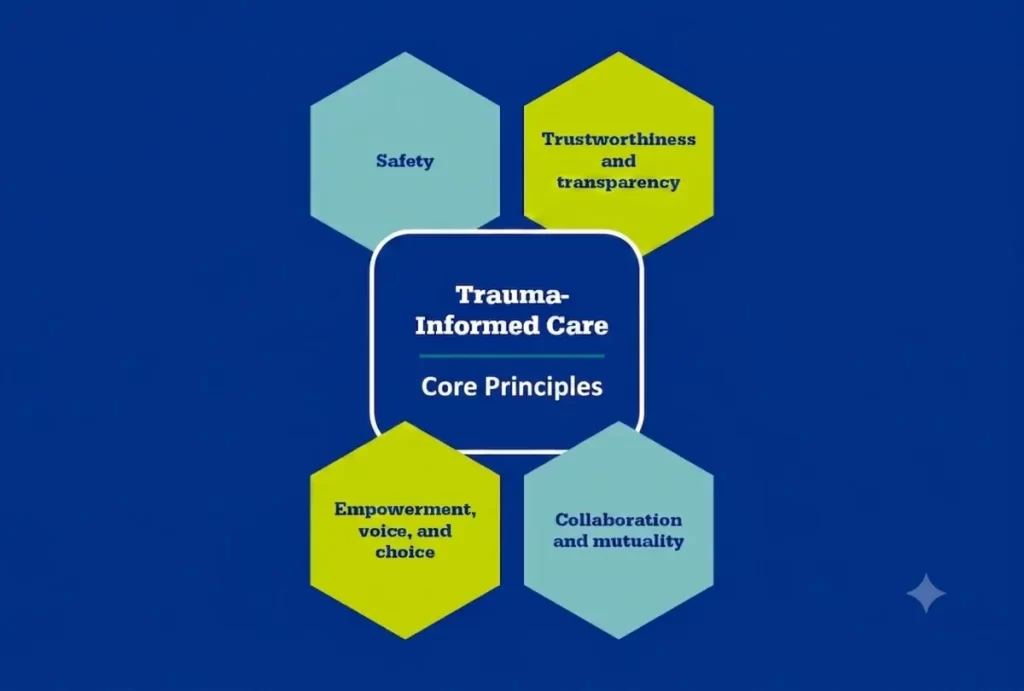
Core Principles of Trauma Informed Care
Healthcare organizations aiming to turn this exclusive approach into a reality should base themselves on essential principles. For instance, at Open Minds Psychiatry, not only do these fundamentals influence our therapeutic decisions but patient experience as well:
1. Ensuring Total Safety First
Mental and physical safety are weaved in the fabric of a clinical recovery process. Not just the trauma-informed nature of a facility ensures that patient areas such as waiting rooms or examination rooms are calm, inviting, and members interacting through telehealth have the feeling of an entirely non-threatening atmosphere. Only when the patient feels secure is the sympathetic nervous system able to decrease the level of tension due to high alert, a constant state.
2. Building Trustworthiness and Transparency
Trauma breaks trust in such a deep way that sometimes it is hard to give it back even the same person, the same institution, or the same environment that caused harm. Psychiatrists should be very careful and systematic in restoring trust. For example, they should be open with patients about what will happen in each step of the psychiatric session, from explaining the reason of a certain question to describing how a particular medication works. Patients should never get the feeling that there are hidden goals or sudden changes in their treatment plan.
3. Emphasizing Collaboration and Mutuality
Medicine in its standard form has traditionally been based on a fairly strict hierarchy of power where the doctor gives orders and the patient just follows. Trauma informed therapy, on the other hand, is committed to leveling the playing field. We can say that a psychiatrist plays a role of clinical mentor yet at the same time we should recognize that a patient is the best judge of their own body and life experiences. In fact, the most important decisions about medication, lifestyle changes, and therapy are all taken jointly as equal partners.
4. Empowering, Giving Voice, and Choice
When someone experiences trauma, their sense of autonomy and control is taken away from them. For this reason, the recovery journey should intentionally be about giving back that control. Patients are constantly given clear options about what comes next. They can speak up to establish boundaries, control the rhythm of therapy according to how comfortable they feel, and be deeply involved in deciding their own healing targets.
The Integrated Treatment Approach
Authentic healing necessitates viewing the whole person. In most cases, successful mental health treatment doesn’t depend on just one method; it merges cutting-edge psychiatry with tailored therapies that address the mind-body relationship.
Trauma-Informed Therapy
Medications might be very helpful in regulating the nervous system and combating the symptoms like panic and depression. However, their effectiveness is heightened when they are administered with trauma-informed therapy that targets the issues specifically.
The main problem with conventional talk therapy is that it overlooks the stress that resides in the body and instead, keeps the patient ruminating intellectually about what happened. On the other hand, trauma therapy works by helping the brain to re-process the problematic memory, thus, the emotional impact of the trauma is diminishing with time. Among the different types of treatments are:
- Cognitive Behavioral Therapy (CBT): It entails recognizing and altering negative thought patterns that have been established due to difficult life experiences.
- Somatic Experiencing: This is a method where patients gradually become aware of their bodily experiences as a safe way to depose traumatic energy in the body.
- EMDR (Eye Movement Desensitization and Reprocessing): In this treatment, bilateral stimulation is used to help the brain re-categorize traumatic memories so that they are seen as past events rather than present dangers.
Continued Trauma Therapy
Keeping a steady approach is essential for the retraining of an overly stimulated nervous system. Through the time, the brain through the method of relentless trauma therapy is being trained to open the doors for the healthy neural tracts and presenting them as a new normal. Periodic professional help will equip the patients with the tools they can rely on when dealing with their emotions, making them stronger emotionally, and also having better interpersonal relationships.

A Path Forward with Open Minds Psychiatry
The side effects of trauma may sometimes make us feel lonely, tired and like we have lost our control. However, going beyond survival and finding genuine peace, presence, and vitality is totally doable.
At Open Minds Psychiatry, we are aware of the tremendous courage it takes to seek help. Our clinical method is based on understanding at a deep level, talented clinical work, trauma informed care without compromise. We give every person who comes to us for help the great dignity, respect, and special attention that they deserve.
If you are willing to see how psychiatry which centers on healing and is highly personalized can change your mental health experience, our kind-hearted staff is ready to accompany you every step of the way. Healing does not mean erasing the past but it means taking back your present.
Frequently Asked Questions
Conventional psychiatry usually concentrates mainly on identifying and dealing with symptoms or imbalances in the brain chemicals that stand on their own. Trauma-informed psychiatry, on the other hand, changes the question from “What’s wrong with you?” to “What happened to you?” The underlying idea being that it recognizes the extent to which a past emotional or physical trauma changes the nervous system and has an impact on one’s present mental health.
Trauma care does not require you to disclose every explicit detail of your previous experiences. We deliver your treatment at a speed that suits your comfort level at Open Minds Psychiatry. The main goal of trauma informed therapy is to assist your brain and your body to understand the emotional and physical effects of distress in a manner that is safe for you, and it does not require you to go through the traumatic memories again.
Using meds is quite common in trauma care to calm an extremely unsettled nervous system one dose, ease that very serious anxiety, and up happiness in long-lasting depression situations. A medication-facilitated trauma care model encourages teamwork with pharmacy while aiming to provide that emotional stability required for ongoing trauma therapy to be effective.